
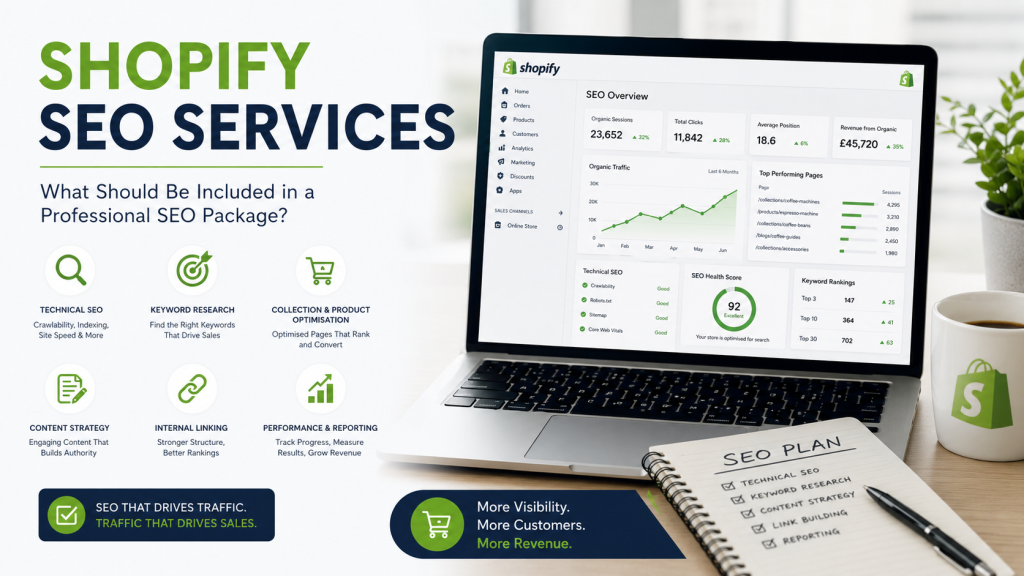
Quick answer: Shopify SEO services should cover technical SEO, keyword research, collection page optimisation, product page optimisation, content strategy, internal linking, and performance monitoring — all delivered by someone with direct Shopify platform knowledge. Generic SEO packages that ignore Shopify-specific issues like duplicate product URLs, canonical tag handling, and collection page structure typically underdeliver.
Shopify is a capable ecommerce platform, but its architecture creates SEO challenges that generic search engine optimisation services are not equipped to solve. Duplicate product URLs generated by collection paths, the platform’s handling of canonical tags, faceted navigation creating thin pages at scale, and the relationship between theme code and crawlability — these are Shopify-specific problems that require Shopify-specific knowledge.
Store owners searching for SEO help often encounter packages built around general best practice: keyword research, some on-page work, and a monthly report. That work is not without value, but it frequently misses the structural and technical issues that are suppressing rankings at the platform level.
This guide explains what Shopify SEO services should genuinely include, what to expect from a specialist consultant, and how to evaluate whether a provider actually understands the platform.
What Are Shopify SEO Services?
Shopify SEO services are a collection of technical, structural, and content-focused activities designed to improve a Shopify store’s organic search visibility. Delivered well, they address:
- Technical SEO — ensuring search engines can crawl, index, and interpret your store correctly
- Keyword research — identifying the terms your target customers use at different stages of purchase intent
- Collection page optimisation — the most commercially important pages in most Shopify stores, and frequently the most neglected
- Product page optimisation — titles, descriptions, structured data, and alt text that support both rankings and conversion
- Content strategy — building topical authority through blog content, buying guides, and comparison articles that support collection and product pages
- Internal linking — creating a logical site architecture that distributes link equity and guides users through the store
- Digital authority — building a credible backlink profile that signals trust to search engines
- Performance monitoring — tracking rankings, crawl health, and commercial outcomes over time
The relative priority of each area depends on your store’s starting point. A technically sound store with weak collection pages needs different work than a store with strong content but crawlability problems.
Shopify Technical SEO
Technical SEO forms the foundation. Without it, every other effort is working against a structural handicap.
Key technical areas in a Shopify context include:
Crawl and indexation — confirming that your important pages (collections, products, key landing pages) are indexed and that low-value pages (internal search results, tag pages, duplicate filter combinations) are handled correctly.
Canonical tags — Shopify automatically generates canonical tags for products accessed through collection paths (e.g., /collections/shoes/products/item canonicalises to /products/item). This is correct behaviour, but it must be verified, particularly after theme changes.
Duplicate product URLs — Shopify’s URL structure means a single product can be accessed from multiple paths. Understanding how these duplicates arise and how canonicalisation handles them is essential to avoiding crawl budget waste.
Collection filtering — faceted navigation (filtering by size, colour, or price) can generate large volumes of thin or near-duplicate URLs. These must be handled correctly to avoid index bloat.
XML sitemap — Shopify generates a sitemap automatically, but it should be verified for accuracy and submitted via Google Search Console.
robots.txt — Shopify’s robots.txt is now editable (since Shopify 2.0) and should be reviewed to ensure it is not inadvertently blocking important content.
Broken links and redirects — identifying 404 errors and redirect chains, then resolving them cleanly.
Structured data — product schema, breadcrumb markup, and organisation schema should be implemented at the theme level and validated using Google’s Rich Results Test.
Core Web Vitals — Largest Contentful Paint, Cumulative Layout Shift, and Interaction to Next Paint are Google ranking signals. Improving them requires both development and SEO knowledge.
Shopify Keyword Research
Keyword research for Shopify stores differs from keyword research for informational websites. The primary focus is commercial intent: what are people searching for when they are ready, or nearly ready, to buy?
A structured approach covers:
- Product-level keywords — specific product names, models, and descriptors with high purchase intent
- Collection-level keywords — broader category terms that map to collection pages (e.g., “women’s leather boots UK”)
- Informational keywords — research-phase queries that support content strategy (e.g., “how to choose a standing desk”)
- Commercial investigation keywords — comparison and review searches where buyers are evaluating options
- Long-tail keywords — lower-volume, higher-specificity terms that are often easier to rank for and convert well
- Keyword mapping — assigning keywords to specific URLs to establish clear, non-competing targets across the site
- Cannibalisation checks — identifying where multiple pages are competing for the same terms and resolving the conflict
A Shopify SEO consultant who understands the platform will map keywords to the correct page type — not assign product-intent queries to a blog post, or attempt to rank a product page for informational queries.
Collection Page SEO
Collection pages are the commercial backbone of most Shopify stores. They aggregate products under a shared topic and, done well, rank for high-intent category queries that drive qualified traffic.
Effective collection page SEO includes:
- Ensuring each collection targets a distinct, clearly defined topic with sufficient search demand
- Writing descriptive
H1headings that reflect the primary keyword and communicate what the collection contains - Adding collection-level copy that supports the keyword target and provides genuine context for users
- Naming products within the collection in a way that reinforces the collection’s topic without being repetitive
- Building internal links from collection pages to related collections and relevant blog content
- Managing faceted navigation carefully to prevent thin page proliferation
- Adding FAQ content where it addresses genuine customer questions and supports long-tail keyword targets
- Writing unique meta titles and descriptions that differentiate each collection in search results
A collection page with no copy, a generic title, and no internal links is leaving search visibility on the table — regardless of how well-optimised the products within it are.
Product Page SEO
Product pages serve two audiences simultaneously: search engines and buyers. Optimising them requires balancing keyword relevance with conversion-focused copy.
A thorough approach to product page SEO includes:
- Product titles — written to reflect how customers search, not just internal naming conventions
- Product descriptions — unique, useful copy that goes beyond the manufacturer’s description and addresses buyer questions
- Alt text — descriptive text for product images that serves both accessibility and image search
- Product schema — structured data marking up price, availability, reviews, and SKU data for rich result eligibility
- Reviews — customer review content adds unique text to product pages and supports long-tail keyword coverage; reviews must be crawlable to provide this benefit
- Related products — internal links to complementary products improve crawl depth and average session value
- Google Merchant Centre — for stores running Shopping campaigns, ensuring product data is accurate and complete is both an SEO and paid channel consideration
Shopify Content Marketing
Content marketing builds the topical authority that collection and product pages benefit from. A Shopify store that publishes useful, well-structured content around its product categories signals expertise to search engines and captures research-phase traffic that converts later.
Effective content for Shopify stores typically includes:
- Buying guides — “How to choose ” articles that rank for research-phase queries and link to relevant collections
- Comparison content — “X vs Y” articles that target commercial investigation searches
- Problem-solution articles — addressing the questions your customers ask before buying
- Category education content — explaining product categories, materials, specifications, or use cases to users who are unfamiliar with them
The content strategy should prioritise topics that support collection and product page rankings — not blog posts that have no commercial connection to what the store sells.
What Should a Monthly Shopify SEO Service Include?
A monthly retainer with a Shopify SEO specialist should deliver consistent, documented progress. At a minimum, monthly activity should include:
- Technical monitoring — crawl health checks, indexation monitoring, Core Web Vitals tracking, and resolution of new technical issues
- Keyword tracking — position monitoring for target keywords across collections, products, and content
- Collection improvements — iterative optimisation of collection page copy, titles, and internal links based on performance data
- Content briefs or production — planning or delivering content that supports the store’s topical authority
- Internal link updates — identifying new linking opportunities as content grows and collection pages develop
- Search Console analysis — reviewing impressions, clicks, crawl errors, and coverage issues monthly
- Competitor research — monitoring how competitor stores are evolving and identifying opportunities
- Reporting — a clear summary of what was done, what changed, and what is planned next
Vague monthly reports listing “SEO work completed” without specific deliverables or measurable outcomes are a warning sign. A good Shopify SEO consultant is specific about what they did and what it achieved.
How Long Does Shopify SEO Take?
There are no responsible guarantees on ranking timelines. Outcomes depend on factors that vary considerably between stores:
- Existing domain authority — an established store with backlinks and indexed history moves faster than a new one
- Competition — ranking in a niche with few well-optimised competitors takes less time than competing with large, well-resourced retailers
- Store size — larger stores with hundreds of collection and product pages require more work before improvements compound
- Technical condition — a store with significant crawlability problems or unresolved duplicate content issues needs technical work before content and keyword efforts have their full effect
- Content quality — thin, templated content limits how far collection and product pages can progress in competitive SERPs
- Implementation speed — recommendations that are implemented quickly produce results faster than those sitting in a backlog
For most Shopify stores, meaningful organic improvement becomes visible within three to six months of consistent, correctly prioritised work. Competitive categories take longer. Early-stage technical fixes can produce faster wins.
Questions to Ask a Shopify SEO Consultant
Before engaging any Shopify SEO service, ask:
- What experience do you have with ecommerce SEO specifically? General SEO knowledge does not transfer directly to ecommerce architecture.
- Do you understand Liquid and Shopify theme code? Some SEO issues require development-level fixes; a consultant who cannot work at this level will be dependent on a separate developer.
- Can you implement changes directly, or do you only produce recommendations? Recommendations that depend on others to implement are slower to take effect and create accountability gaps.
- How do you measure success beyond traffic? Organic revenue, conversion rate from organic traffic, and revenue per landing page are more useful measures than raw traffic volume.
- How do you approach collection page optimisation? A specific, informed answer indicates platform knowledge; a generic answer about “meta tags and keywords” does not.
- How do you prevent traffic loss during site changes? A Shopify SEO consultant who understands redesign risk, redirect planning, and URL management will give a detailed, practical response.
Shopify SEO Services From SEO Tailor
SEO Tailor combines Shopify development and SEO expertise in a single, direct service. There are no handoffs between a developer and an SEO team. When a technical fix is needed, it is implemented directly. When a collection page needs restructuring at the theme template level, that work happens without delay.
Garry Butcher is a Shopify Select Partner based in Leamington Spa, Warwickshire, working with UK businesses that want SEO delivered by someone who genuinely understands the platform — not a generalist agency that treats Shopify as one CMS among many.
The service is direct, practical, and focused on outcomes rather than activity metrics.
Discuss your Shopify SEO requirements with SEO Tailor →
Frequently Asked Questions
What makes Shopify SEO different from general ecommerce SEO?
Shopify’s platform architecture creates specific challenges — duplicate URLs from collection paths, limited control over certain URL structures, automatic canonical tag behaviour, and a theme-driven approach to structured data. These require platform-specific knowledge that general ecommerce SEO experience does not automatically provide.
Do I need a Shopify developer and an SEO consultant separately?
Not necessarily. Many technical SEO issues in Shopify require changes to theme code, Liquid templates, or structured data — work that sits at the intersection of development and SEO. A service that provides both reduces delays, removes handoff friction, and ensures technical decisions are evaluated for SEO impact from the outset.
How much do Shopify SEO services cost in the UK?
Monthly retainers vary depending on the scope of work and the size of the store. Specialist Shopify SEO services in the UK typically range from £750 to £2,500+ per month, depending on whether the service includes development work, content production, and the number of collection and product pages being actively optimised.
Can Shopify SEO services help with Google Shopping as well as organic search?
Yes — product schema, Google Merchant Centre feed quality, and product page structure affect both organic Shopping results and paid Shopping campaigns. A Shopify SEO specialist with experience in structured data can improve visibility across both channels.
Is ongoing Shopify SEO necessary, or is a one-time audit enough?
An audit provides a useful starting point, but SEO is not a one-time task. Search competition, algorithm updates, site changes, and content gaps all require ongoing attention. A one-time audit that is never fully implemented typically produces limited results.