
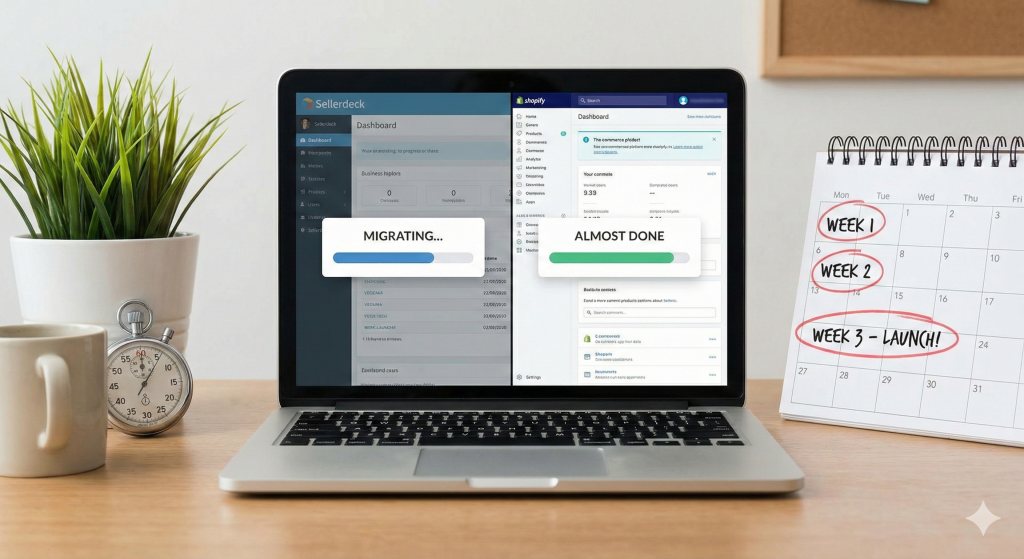
If your online store is still powered by Actinic 8, Sellerdeck 2013, Sellerdeck 2016, or even the more recent Sellerdeck 2018, you are likely operating with one hand tied behind your back. While these platforms served the UK e-commerce market well for years, the digital landscape has shifted dramatically. Today, staying on legacy desktop-based software doesn’t just mean standing still—it means moving backwards while your competitors race ahead.
Many business owners delay migration because they fear a long, drawn-out process filled with downtime and technical headaches. But what if you could revitalise your business, secure your data, and unlock massive growth potential in just three weeks?
Migrating from Sellerdeck to Shopify is not just a technical upgrade; it is a strategic escape from obsolescence. This guide explores why moving your store is urgent, why the “easy” option of EKM might not be the best choice, and how an expert freelancer with deep Sellerdeck knowledge can transition your business seamlessly.
The Hidden Cost of Sticking with Actinic and Sellerdeck
For many merchants, Actinic and Sellerdeck feel like a comfortable pair of old shoes. You know the quirks, you have mastered the workarounds, and “if it isn’t broken, don’t fix it,” right? Unfortunately, in e-commerce, “not broken” is not enough.
Users on versions like Actinic 8 or older Sellerdeck releases are missing out on fundamental features that modern consumers take for granted.
1. The Mobile Gap
Older Sellerdeck sites often struggle to provide a truly responsive, mobile-first experience. With over 70% of e-commerce traffic now coming from mobile devices, a clunky mobile interface is a conversion killer. Modern shoppers expect seamless browsing, swipeable galleries, and instant checkout on their phones.
2. Marketing Isolation
Modern e-commerce thrives on connectivity. Platforms like Shopify integrate effortlessly with Instagram, TikTok, Google Shopping, and advanced email marketing flows. Sellerdeck’s desktop architecture makes these real-time integrations incredibly difficult, if not impossible, leaving you unable to reach new audiences effectively.
3. The “Desktop” Bottleneck
Perhaps the biggest limitation is the workflow itself. Relying on a specific PC to process orders, update stock, and “upload” changes prevents agile working. You cannot manage your store from a laptop on holiday or check orders via an app. Your business speed is limited by your upload speed.
The EKM Option: Why It’s Often a Sideways Move
Since Sellerdeck was acquired by ClearCourse, many users are being encouraged to migrate to EKM, another platform under the same ownership umbrella. On paper, this looks like a logical step. EKM is a cloud-based system (SaaS), solving the desktop dependency issue, and it offers some good features for UK merchants.
However, moving to EKM is often a lateral move rather than an upgrade. Like Sellerdeck, EKM operates as a “walled garden.”
- Shared Limitations: EKM lacks the vast, open ecosystem of third-party developers that global platforms enjoy. If a feature isn’t built by EKM, you generally can’t have it.
- Design Restrictions: While better than Sellerdeck, EKM’s templates can be rigid, making it hard to create a truly bespoke brand experience.
- The Competitiveness Gap: EKM simply cannot compete with the R&D budget of a global giant like Shopify. When new payment technologies or marketing trends emerge, closed platforms are often slower to adapt.
Migrating to EKM might solve today’s hosting problem, but it often leaves you facing the same scalability ceilings a few years down the line.
Why Shopify Offers Major Business Growth
Shopify is not just a platform; it is a growth engine. It is designed to work for your business, automating the mundane so you can focus on strategy. Unlike Sellerdeck, where your business often has to work around the software’s limitations, Shopify moulds to fit your ambition.
Here are the main features driving this growth:
- World-Class Checkout: Shopify’s checkout is optimised for speed and conversion. Features like Shop Pay allow customers to check out in seconds, significantly reducing cart abandonment.
- App Ecosystem: The Shopify App Store contains thousands of tools. Need a complex loyalty program? There’s an app for that. Need advanced subscription management? Done. You can extend your store’s functionality infinitely.
- Marketing Automation: Shopify allows you to set up automated email flows (like abandoned cart recovery) that run in the background, generating revenue while you sleep.
- Scalability: Whether you sell ten products a day or ten thousand, Shopify’s cloud infrastructure scales instantly. You never have to worry about server crashes during Black Friday or seasonal peaks.
Why Experience Matters: The SEO Tailor Advantage
Migrating a store is surgical work. It requires precision to ensure data integrity and SEO preservation. This is why choosing a freelancer with specific Sellerdeck experience is non-negotiable.
At SEO Tailor, we have over 10 years of experience developing and managing Sellerdeck stores. We don’t just know Shopify; we understand exactly how Sellerdeck is built. We know the database structure of Actinic 8 and the template quirks of Sellerdeck 2016.
The 3-Week Turnaround
For many standard stores, we can execute a complete migration in as little as three weeks. This efficiency comes from experience. We don’t waste time figuring out how to export your data—we have done it hundreds of times.
Our process ensures:
- Minimal Disruption: We build your new Shopify store in the background while your Sellerdeck store remains live and trading. The switch-over happens seamlessly, often with zero downtime.
- Data Integrity: We ensure complex product data, variants, and customer histories are transferred accurately, cleaning up legacy messy data in the process.
Protecting Your SEO: The Critical /acatalog/ Redirects
The biggest fear for any merchant migrating their store is losing Google rankings. If you have been running a Sellerdeck site for a decade, you have built up valuable “link juice.”
Sellerdeck uses a very specific, and somewhat archaic, URL structure, typically involving /acatalog/ in the web address (e.g., www.yoursite.com/acatalog/product-name.html).
If you simply move to Shopify, all those old links will break. Any customer clicking a bookmark, or any user clicking a search result on Google, will hit a “404 Not Found” error. Google will immediately drop your rankings.
The Solution:
Because we understand the /acatalog/ structure, we implement comprehensive 301 redirects. We map every single old Sellerdeck URL to its new, clean Shopify equivalent. This tells Google, “This page has moved here.” It preserves your rankings, maintains your traffic, and ensures a smooth experience for customers following old links.
Conclusion: Stop Working Around Limitations
If you are using Sellerdeck 2013, 2016, or 2018, you are likely spending hours every week managing software updates, fixing database errors, or trying to hack together workarounds for modern features. That is time stolen from growing your business.
Shopify offers a future where technology is an accelerator, not a brake. With the right partner, the transition can be fast, safe, and immediately profitable. Don’t let legacy software dictate your ceiling.
Ready to modernise your business in just 3 weeks? Let’s discuss your migration plan.